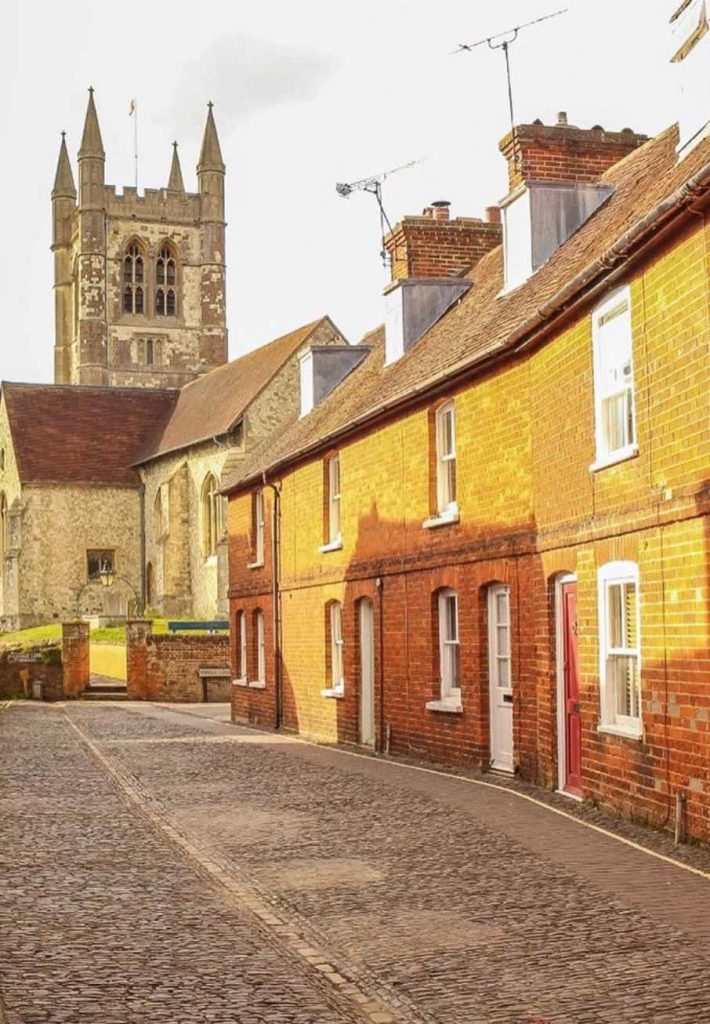
A Saxon community then grew up in the valley by the river giving the town organised agriculture, its parish church (now St Andrews’) and also its name, ‘Fearnhamme’, roughly translated as ‘well-watered meadow by the ferns’. Most of the town’s local names are derived from the Saxon language and the town’s links with craft continued with the discovery of several Saxon weaving huts from circa 550AD in 1924 at Saxon Croft, just off Firgrove Hill.
By 803AD, Farnham had passed into the ownership of the Bishop of Winchester and so it remained (apart from two short breaks) for the next thousand years. By 1086, Farnham appears in the Domesday Book as Ferneham, one of the five great minster churches in Surrey. Its assets included 40 hides; one church, six watermills and 43 ploughs.
In 1138, Henry de Blois (grandson of William the Conqueror) started building Farnham Castle to provide accommodation for the Bishop of Winchester in his frequent journeying between his cathedral and the capital. The castle’s garrison provided a market for farms and small industries in the town, accelerating its growth. The palace and deer-park were added in the 13th century, and remain treasured spaces to this day. The castle’s architecture reflects changing styles through the ages and it has become one of the most important historical buildings in the south of England. Monarchs and noblemen became regular visitors to the town including King John, Queen Victoria and Henry VIII. When Elizabeth I visited, she bought her Court along too and ran the country from Farnham for six months. Later, during the Second World War, the castle became the home of the Camouflage Development and Training Centre (CDTC) of the Camouflage Branch of the Royal Engineers. Here, artists such as Roland Penrose and Julian Trevelyan as well as the magician Jasper Maskelyne were trained in the art and craft of military camouflage.